| | 1 | = PoPLaR In-Person Update and Status Meeting = |
| | 2 | |
| | 3 | Attended: JMcG, KL, MH, RW, JP, EM, CD, NK, MP, MB, AFr, PH, TP, SG, JL, ND |
| | 4 | |
| | 5 | == Meeting Notes == |
| | 6 | |
| | 7 | === Phase 2 Analysis === |
| | 8 | |
| | 9 | ==== Radiobiology Results ==== |
| | 10 | The aim going into the experiment was to get the first results towards reproducing the survival curves seen using Birmingham's MC40. |
| | 11 | Phase 2 used post-plating, which allows for more statistics and provides better survival than pre-plating. Due to previous controls, a lack of survival, 1mm of media was added to the cell dish, which improved survival. |
| | 12 | Completed a dry run at SCAPA, where the cells were held vertically for 20minutes. This test saw good survival in both HeLa and FaDu cell lines. The results were studied 10 days post-seeding. |
| | 13 | However, in the actual irradiations, only the FaDu saw any survival. Two obvious factors for this are the uncertainty in the delivered dose and the increased time the cells were vertical for. The general operation of the irradiations meant that the cells were probably out for 1-1.5 hours. Most of this was because we were unaware that we needed to limit the time the cells were out for. This can be reduced further by reducing the time between shots, as well as not shooting RCF in the same carousel. Secondly, the actual irradiations were aiming to deliver 1, 2 and 4Gy using 4, 7 and 14 shots, but mroe likely delivered nearly twice that dose, with a large shot-to-shot variation in the dose delivered. This meant the seeding densities were off. |
| | 14 | In the FaDu, a survival curve was seen, though with the dose uncertainty, it is hard to draw any conclusions. The plating efficiency was also at a lower level across the board, most likely due to the time out rather than the variation in dose. Having said this, the survival curve did look realistic. |
| | 15 | |
| | 16 | ===== In Summary ===== |
| | 17 | Two main problems are the uncertainty in the delivered dose and the time the cells are vertical for. |
| | 18 | Uncertainty in the delivered dose can be improved by using an in-beam diagnostic |
| | 19 | Time cells can be reduced by |
| | 20 | * Being aware of the issue |
| | 21 | * Reducing the time between shots (From 20 seconds to 5 seconds) |
| | 22 | * Not irradiating RCF in the same carousel |
| | 23 | * For 4, 7, 14 so these two would decrease from 16 mins and 40 seconds to 4 mins 10 seconds. Still |
| | 24 | * Understanding how long the cells can be out for before dying |
| | 25 | |
| | 26 | ==== RCF Analysis ==== |
| | 27 | The RCF was collected in two types. 20 in 5cm square pieces and 30 in 1.5cm square pieces. The aim was to characterise the shot-to-shot variation and the spatial variation to give an uncertainty on each dose delivered. By assuming that the shot-to-shot variation was normally distributed and performing a maximum likelihood fit on the mean dose and the shot-to-shot uncertainty, we calculated the mean dose to be 0.57Gy with a shot-to-shot variation of 0.40Gy. The reduced chi-squared of the fit is 1.05. The coefficient of variation was 13.93% ± 1.79% and showed no obvious dependence on the dose delivered. This meant that for the relevant shot counts, (4,7,14), the predicted dose was 2.28±0.87Gy, 3.98±1.21Gy and 7.97±1.87Gy. There were also 8 pieces of RCF collected when the Cu scatterer was moved closer to the laser target. This reduced the median CV from 14.06% to 7.88%. This is still not low enough to be completely satisfactory, but much closer. It also means that we delivered around half the dose per shot. |
| | 28 | |
| | 29 | |
| | 30 | === SCAPA Beamline Analysis === |
| | 31 | |
| | 32 | We have completed the allocated days currently at SCAPA. Currently, 4 types of beamline end that can be installed: |
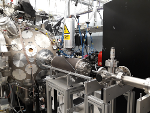
| | 33 | * TP-Vacuum Mode |
| | 34 | * RCF Stack |
| | 35 | * Proton Focus Imager (Lanex) |
| | 36 | * Cell Irradiation (Carousel) |
| | 37 | In phase 1 saw a maximum source energy of 12±2MeV. This increased to 14.4±1.2MeV, which could be due tp higher pulse intensity, but this does not fully explain the result. There was a comparison made between Kapton and Steel targets. Steel produces a much more circular proton beam but leads to EMP issues. |
| | 38 | Starting to investigate proton source instabilities as the potential cause of the shot-to-shot variation. There is a noted decrease in max source energy by 1MeV over 120 shots. This occurs due to debris buildup in the laser near-field spatial-intensity profile. Robbie also has a student that has started to reproduce dose variations byt varying the source energy spectrum. Would be interesting to further vary the spatial distribution and the angular distribution and see if these are enough to explain the change in dose. Needs to include the PMQs in the models as well. |
| | 39 | For the next beamtime, there are 3 key areas to work on: |
| | 40 | * Cell Studies |
| | 41 | * Developing/Adding Further Beamline Elements |
| | 42 | * Diagnostic Development, including Diagnosing the Source of the Variation |
| | 43 | The third of these is the most pressing |
| | 44 | Based on availability, the best time for new beamtime would be around July/August. |
| | 45 | |
| | 46 | |
| | 47 | === Instrumentation === |
| | 48 | |
| | 49 | ==== Sparse Scintillating-Fibre Array ==== |
| | 50 | |
| | 51 | |
| | 52 | |
| | 53 | ==== Air Scintillation ==== |
| | 54 | |
| | 55 | ==== Tony's Suggestions ==== |
| | 56 | |
| | 57 | ==== RCF Use and Potential Diagnostic ==== |
| | 58 | |
| | 59 | Diaza has written an RCF protocol explaining key issues, including film orientation and placement, scanner warm-up and the Callier effect. For the last one, we require a glass sheet to cover the film when being scanned. Further reading was undertaken on the RCF calibration and a technical document will be added to the wiki to describe the best practice. One key insight is that using the Polynomial Model but fixing c provides a much lower error when calculting the dose at little cost to the accuracy of the measurement. The error reduced from between 5 and 16% to 3-4.5% in a range of 0-18Gy. It was also suggested that a calibration could be undertaken using all three channels as this reduces the error further. |
| | 60 | |
| | 61 | The larger RCF films were then used to determine whether placing RCF around the edge of the cell dish would allow you to estimate accurately the mean dose in the cell dish. It was found that measurement error alone could not explain the residuals from the linear fit, so a constant error term to measure the film-to-film variation was added. Once this uncertainty was increased to 0.23Gy the reduced chi-squared dropped from around 6 to around 1. This means that this error will become substantial at low doses. |
| | 62 | |
| | 63 | Simulations were then undertaken to determine whether placing a piece of delaminated EBT3 would be a sensible approach. They suggested that the introduction of the RCF would increase the track-LET from 5.7 KeV/um to 6.5 KeV/um and the dose-LET from 6.8 KeV/um to 7.7 KeV/um, ie the RCF causes roughly a 1KeV/um increase in the LET. This was deemed acceptable, though other approaches are still preferred. There is also further analysis required on the ability to use this RCF to predict the delivered dose to the cell dish. |
| | 64 | |
| | 65 | ==== Summary ==== |
| | 66 | |
| | 67 | |
| | 68 | === Looking Forward === |
| | 69 | |
| | 70 | ==== Future Beamlines ==== |
| | 71 | |
| | 72 | ==== Discussion and Summary ==== |
| | 73 | Robbie going to ELI soon |
| | 74 | |
| | 75 | |
| | 76 | Actions Required |
| | 77 | * Get a glass sheet |
| | 78 | |
| | 79 | |
| | 80 | |
| | 81 | === Summary of actions required === |
| | 82 | |
| | 83 | Phase 2 Analysis |
| | 84 | - **EM**: Evaluate the cell results |
| | 85 | - **CD, AFr**: Complete analysis of RCF with errors |
| | 86 | - **EM/ED/LJ**: Send calibration films to SCAPA and scan them in both orientations |
| | 87 | - **CD, RW and AFr**: Explain scanning procedure |
| | 88 | - **EM, JMcG**: Write up summary of PoPLaR Phase 2, including technical summary of cell irradiation procedure |
| | 89 | - **MB**: Comet analysis |
| | 90 | - **CD**: Invite Liverpool, Chris Armstrong and LMU to join the in-person meeting |
| | 91 | |
| | 92 | Beam Diagnostics |
| | 93 | - **Unassigned**: Find all the errors associated with RCF |
| | 94 | - **RW, CD**: Study correlation between laser diagnostics and mean dose |
| | 95 | - **CD, TP**: Evaluate LET in the cells with the RCF in front |
| | 96 | |
| | 97 | Improve Bio results |
| | 98 | - **EM**: Inform Roshine when to defrost Glioma cell line |
| | 99 | - **Unassigned**: Obtain an inverted microscope |
| | 100 | |
| | 101 | Long-term |
| | 102 | - **CD, JMcG**: Investigate how to achieve uniformity without a scatterer in place |
| | 103 | - **KL, CW**: Cost 4 or 6 quad, and chicane systems |
| | 104 | |
| | 105 | ---- |