Plasma lens focusing of laser-driven proton and ion beams
Abstract submitted to Applying Laser-driven Particle Acceleration (ALPA) at SPIE Optics and Optoelectronics 2027
Calvin Dyson: for the collaboration
Abstract
Laser-driven ion sources offer potential advantages in a range of disciplines, including radiotherapy, but the beams created have a large divergence, creating significant challenges for conventional beam-transport technologies that often rely on asymmetric focusing and require strong magnetic fields. The Laser-hybrid Accelerator for Radiobiological Applications (LhARA) proposes the use of a Gabor lens as a symmetric focusing system to capture the laser-driven beam. A Gabor lens uses the electrostatic field of a confined electron plasma to focus positively charged particles. The focusing strength is determined by the electron density and length.
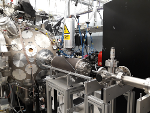
This contribution reports results from a Gabor lens testbench at Swansea University. A Penning-Malmberg trap, comprising a radially confining solenoid and axially confining electrodes, is used to confine an electron plasma produced through seeding background CO2 gas ionisation with an electron gun. Experimental results have explored rotating-wall techniques, oscillating electric fields and the introduction of a dimple potential. The combination of the dimple potential and oscillating fields has improved plasma stability. Peak densities of approximately 8 × 10¹⁴ m⁻³ have been achieved, approaching the design target for the proposed LhARA lens (4 x 10¹⁵ m-3).
Complementary three-dimensional particle-in-cell simulations using WarpX are being developed to support the interpretation and optimisation of experimental measurements. In parallel, preliminary particle-tracking studies indicate that the experimentally achieved plasma density could provide sufficient focusing for positrons, motivating further simulation and experimental validation. Together, these results represent progress towards a stable, sufficiently dense plasma, marking crucial steps in the development of a Gabor lens for the capture and transport of laser-driven ion beams.
Summary for display in the program
Laser-driven ion beams have significant potential for future applications in radiobiology and particle therapy, but their large divergence makes efficient capture and transport challenging. A Gabor lens offers a symmetric focusing solution using the electric field of a confined electron plasma. This contribution presents experimental progress at Swansea University in generating and stabilising the plasma required for such a lens, including improvements achieved using oscillating electric fields and a dimple potential. Complementary WarpX simulations support the development of a practical focusing system for applications such as LhARA.
Biographical information
Calvin Dyson is a third-year PhD researcher at Imperial College London and a member of the LhARA (Laser-hybrid Accelerator for Radiobiological Applications) collaboration under the supervision of Professor Kenneth Long. His research spans several areas across LhARA, with a primary focus on understanding and modelling the experimental results from the Gabor lens testbench at Swansea University. This involves employing WarpX to investigate electron plasma confinement using three-dimensional particle-in-cell simulations. His other contributions within the collaboration include beamline optimisation and characterisation for the PoPLaR experiment, as well as simulations and data analysis for ion-acoustic diagnostics. His research contributes to the development and characterisation of the focusing technologies and diagnostics required to realise LhARA's radiobiological applications.