Changes between Version 4 and Version 5 of Research/LhARA/Communication/Conferences/2027/ALPA-abstract-GbrLns
- Timestamp:
- Nov 9, 2026, 4:46:47 PM (24 hours ago)
Legend:
- Unmodified
- Added
- Removed
- Modified
-
Research/LhARA/Communication/Conferences/2027/ALPA-abstract-GbrLns
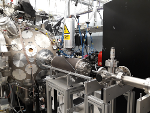
v4 v5 6 6 == Abstract == 7 7 8 Laser-driven ion sources offer potential advantages in a range of disciplines, including radiotherapy, but the beams created have a large divergence, creating significant challenges for conventional technologies that often rely on asymmetric focusing and require strong magnetic fields. The Laser-hybrid Accelerator for Radiobiological Applications (LhARA) proposes the use of a Gabor lens as a symmetric focusing system to capture the laser-driven beam. A Gabor lens uses the electrostatic field of a confined electron plasma to focus positively charged particles. The focusing strength is determined by the electron density and length.8 Laser-driven ion sources offer potential advantages in a range of disciplines, including radiotherapy, but the beams created have a large divergence, creating significant challenges for conventional beam-transport technologies that often rely on asymmetric focusing and require strong magnetic fields. The Laser-hybrid Accelerator for Radiobiological Applications (LhARA) proposes the use of a Gabor lens as a symmetric focusing system to capture the laser-driven beam. A Gabor lens uses the electrostatic field of a confined electron plasma to focus positively charged particles. The focusing strength is determined by the electron density and length. 9 9 10 10 This contribution reports results from a Gabor lens testbench at Swansea University. A Penning-Malmberg trap, comprising a radially confining solenoid and axially confining electrodes, is used to confine an electron plasma produced through seeding background CO2 gas ionisation with an electron gun. Experimental results have explored rotating-wall techniques, oscillating electric fields and the introduction of a dimple potential. The combination of the dimple potential and oscillating fields has improved plasma stability. Peak densities of approximately 8 × 10¹⁴ m⁻³ have been achieved, approaching the design target for the proposed LhARA lens (4 x 10^15 m-3).